
When a sensitive PCB assembly arrives damaged at your customer’s facility, the costs cascade quickly. Beyond the immediate scrap value of the component itself—potentially $50 to $500 per unit for complex electronics—you face expedited replacement shipping, production line delays costing thousands per hour, rework labor, and the intangible damage to supplier relationships and quality metrics. Now consider the alternative: custom thermoformed packaging designed specifically for your component geometry, shipping environment, and handling requirements.
The incremental cost per unit for precision thermoformed trays typically adds just pennies to your landed cost, or a fraction of a single damage event.
This investment in thermoformed packaging for shipping delivers measurable returns through reduced breakage and electrostatic discharge events, faster handling times in your facility with components arriving in correct orientation and ready for line-side use, and elimination of costly repack operations at receiving docks.
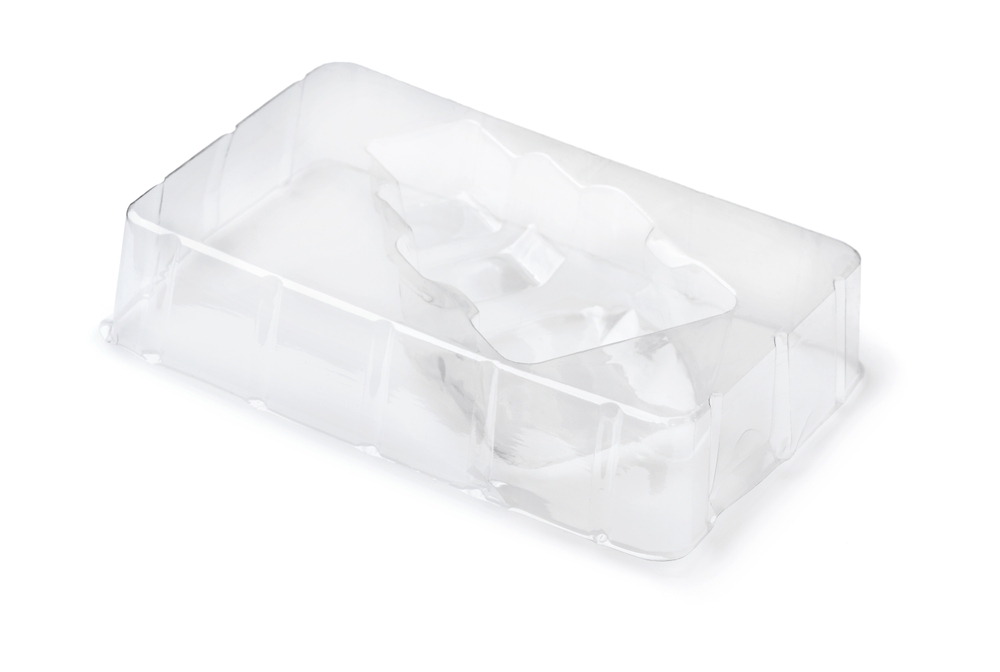
What Is ESD Thermoformed Packaging for Electronics?
ESD thermoformed packaging protects electronic components from electrostatic discharge: the sudden flow of electricity between objects that can damage or destroy sensitive circuitry in PCBs, microchips, sensors, and control modules.
Standard plastic packaging materials can generate and hold static charges that invisibly compromise component reliability, leading to field failures weeks or months after assembly.
ESD thermoformed trays solve this challenge by incorporating static-dissipative or conductive plastic formulations engineered to control charge build-up and safely dissipate static electricity through the tray material rather than allowing it to arc through your valuable components.
These custom thermoformed electronics trays maintain surface resistivity values typically between 10^4 and 10^11 ohms per square, meeting industry standards like ANSI/ESD S20.20 for electronics handling and packaging.
At Complete Packaging Solutions, we focus on secondary protective packaging customized for the electronics industry: the thermoformed trays, clamshells, and inserts that protect components during shipping and internal handling between manufacturing operations.

Best Materials for Thermoformed Protective Packaging
Material selection is the foundation of your packaging’s performance, cost, and sustainability. At Complete Packaging Solutions, we specialize in three primary thermoplastics: HIPS, PET, and PVC.
1. High-Impact Polystyrene (HIPS)
Best for: Industrial trays and high-volume hardware.
- Durability: Offers excellent impact resistance and dimensional stability for heavy parts like automotive fasteners.
- Efficiency: Thermoforms with tight tolerances, ensuring consistent geometry across large production runs.
- Cost-Effective: The go-to choice for high-volume programs where visual clarity isn’t required.
- Static Protection: Easily accepts ESD additives for electronic components.
2. Polyethylene Terephthalate (PET)
Best for: High-visibility shipping and sustainability goals.
- Crystal Clarity: Allows for easy inspection and part verification without opening the package.
- Superior Strength: Maintains structural integrity across varying shipping temperatures.
- Eco-Friendly: Features the most established recycling infrastructure (same as water bottles), making it ideal for meeting aggressive green targets.
- Versatile: Supports both ESD treatments and visual confirmation.
3. Polyvinyl Chloride (PVC)
Best for: Complex designs and reusable systems.
- Exceptional Formability: Perfect for deep-draw applications and intricate geometries.
- Durability: Highly resilient, making it a strong candidate for returnable tray systems.
- Strategic Use: While versatile, PVC has more limited recycling options than PET. We help you weigh its unique performance benefits against your long-term sustainability goals.
How the Thermoformed Packaging Process Ensures a Precision Fit
Our 6-Step Engineering Process
We treat protective packaging as a precision-engineered component. Our systematic turnkey process ensures your trays meet tight tolerances and integrate seamlessly into your operations.
1. Design Discovery
We analyze your CAD files and shipping environment to identify critical needs, such as clearance for fragile features, automation orientation, and stacking height. This phase prevents costly tooling changes later.
2. Custom Tooling and Rapid Prototyping
Our in-house team designs tooling with ergonomics in mind, including finger notches for easy “pick and place” and visual keys for correct part orientation. We typically deliver prototypes in two to four weeks for real-world validation.
3. Material and ESD Engineering
We match the right polymer (HIPS, PET, or PVC) to your protection and sustainability goals. For electronics, we integrate specific ESD treatments to ensure your trays meet all industry static-control standards.
4. Precision Thermoforming and Trimming
Using controlled heating and precision molds, we maintain strict consistency in pocket depth and wall thickness. Advanced trimming ensures smooth edges and adds functional features, like labeling areas or hang holes.
5. Quality Validation and Fit Testing
Before full production, we verify dimensions against your original specs. When possible, we conduct “test packs” with actual parts to ensure retention, fit, and durability under vibration or drop-test conditions.
6. Consistent Production and Support
Whether you need thousands or hundreds of thousands of units, our process ensures every tray is identical. This reliability is vital for automated handling systems and predictable shipping costs.
Standard Trays vs. Custom Thermoformed Trays
Understanding the trade-offs between off-the-shelf solutions and engineered custom thermoformed trays helps you avoid costly packaging mistakes and make informed decisions that align with your program economics and quality objectives.
Attribute | Standard Trays | Custom Protective Thermoformed Trays |
Fit and Part Retention | Loose fit; parts may shift or contact each other during shipping | Precision pockets matched to exact component geometry; parts immobilized |
ESD Protection | Typically, none unless specifically purchased; limited options | ESD materials specified and tested to application requirements |
Optimization for Shipping and Handling | Generic dimensions may waste container space; no ergonomic features | Engineered for specific carton sizes, handling equipment, and operator workflow |
Material Efficiency | Often oversized; excess material and dimensional waste | Right-sized pockets minimize material use while maximizing protection |
Damage-in-Transit Rates | Variable; depends on how well the generic tray matches your parts | Consistently low when properly designed; typical reductions of 50-90% vs. generic packaging |
Upfront Investment | Low or none (purchase ready-made inventory) | Tooling investment typically $2,000-$8,000, depending on complexity |
Long-Term Unit Cost | Appears inexpensive per unit but may require overpack, foam, or additional protection | Optimized cost per unit at volume; often eliminates the need for secondary packaging |
Lead Time | Immediate availability from distributor stock | 2-4 weeks for prototypes; 4-6 weeks for production after approval |
Customization for Automation | No accommodation for robotic handling or specific orientations | Can include features like nest locations, orientation keys, and vision system markers |
Get Your Custom Thermoformed Tray Quote Today
Reducing damage-in-transit, improving handling efficiency, and optimizing your packaging spend doesn’t require lengthy vendor qualifications or complex procurement processes. Complete Packaging Solutions makes it straightforward to explore whether custom thermoformed protective packaging fits your program needs.
Ready to get started? Contact Complete Packaging Solutions to request your custom thermoformed tray quote or schedule a consultation with our team.
Thermoformed Packaging FAQs
Production runs typically start around 5,000-10,000 units to justify tooling investment, though we can discuss smaller quantities for specialized applications. Prototype quantities of 50-100 trays are available for validation before production commitments.
Properly maintained aluminum or composite tooling typically supports 500,000 to 1,000,000+ cycles, easily covering multi-year production programs. Tool life depends on material choice, tray complexity, and production volumes.
Yes. Many customers implement returnable packaging programs where thermoformed trays cycle between facilities. We engineer trays for durability and repeated handling when returnability is part of your packaging strategy.
We work with certified testing laboratories to validate ESD properties when applications require documented compliance with standards like ANSI/ESD S20.20. Material suppliers provide base certifications, and we can arrange additional testing as needed.
Ideal inputs include CAD files or detailed technical drawings, annual volume estimates, description of shipping environment and handling methods, any special requirements like ESD protection or specific material preferences, and timeline for prototypes and production.